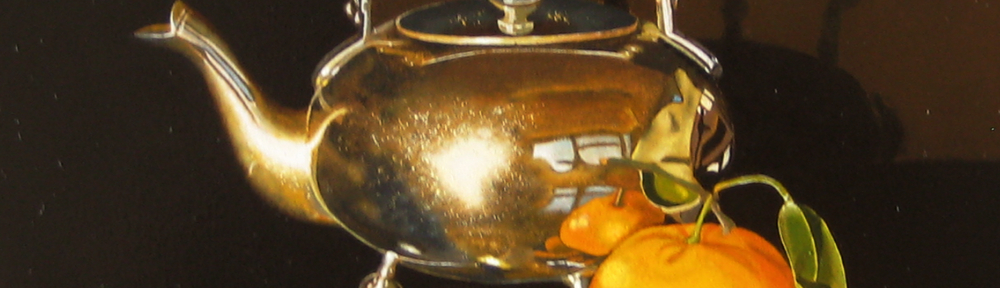
Eiger Trail
6″ x 6″ (15 x 15 cm) oil on gessobord panel.
In the year 2000 my husband and I went to Switzerland and did some wonderful mountain hiking. The absolutely amazing experience was the Eiger Trail near Gimmelwald. I was completely spellbound with its majestic beauty. So much so that I even bought a local souvenir (which I never do, btw) – a local goat toy. These goats are the funniest critters – black in the front, white in the back, curious and fearless creatures. This still life is another one in the Reflections series I am working on.
A few days ago my friend and artist Carol King (Carol King blog) asked about process and steps it takes me to paint these still lives. An excellent question that I promised to answer.
My process:
I usually start with an idea. The idea can be visual – color I like, line that is intriguing, texture I haven’t tried before. Or it can be intellectual – memories, poetry, or emotions that touched me. This idea brings forward objects that could express it. I often have to hunt for these objects in thrift stores or borrow them from my friends and family – sorry, guys!
I make numerous compositions from objects I assembled and experiment with light. Following Norman Rockwell’s methods I take dozens of photos of my various setups in various lights.
Bringing the photos to my computer I sort and discard. With the remaining few I work on crop and composition. Half the time I can’t get an image that satisfies, and when this happens I go back to playing with my objects and light and camera.
Once I have a composition I like, I draw it in pencil. I often use grid method working from my computer screen and make my drawing as accurate as I can. At this stage I make decisions about details and routinely skip and omit portions that I don’t want in a future painting.
I rub the back of the drawing with vine charcoal creating a transfer surface and transfer the image onto the gessobord. Gessobord by Ampersand is my preferred surface because it is very smooth. The transferred charcoal image gets corrected and then fixed with Krylon fixative.
When fixative is dry I put in an imprimatura layer. I like my paintings to have warmth coming from within, so my usual imprimatura is done in yellow ochre or burnt sienna or burnt umber or a combination of them.
I use Gamblin oils, Gamsol for solvent, and Galkyd Slow Dry medium. Here is the list of my colors:
- yellow ochre
- burnt sienna
- burnt umber
- alizarin crimson
- venetian red
- cadmium red light
- cadmium yellow light
- cadmium yellow medium
- cadmium orange
- viridian
- ultramarine blue
- cerulean blue
- payne’s grey
- portland grey
- ivory black
I use two whites – titanium and flake white.
I would give you my preferred brushes too, except I don’t have them. I have many brushes I use and dislike to various degrees, some more and some less. But I haven’t found brushes that would do what I want without a struggle. I will write about brushes in another post.
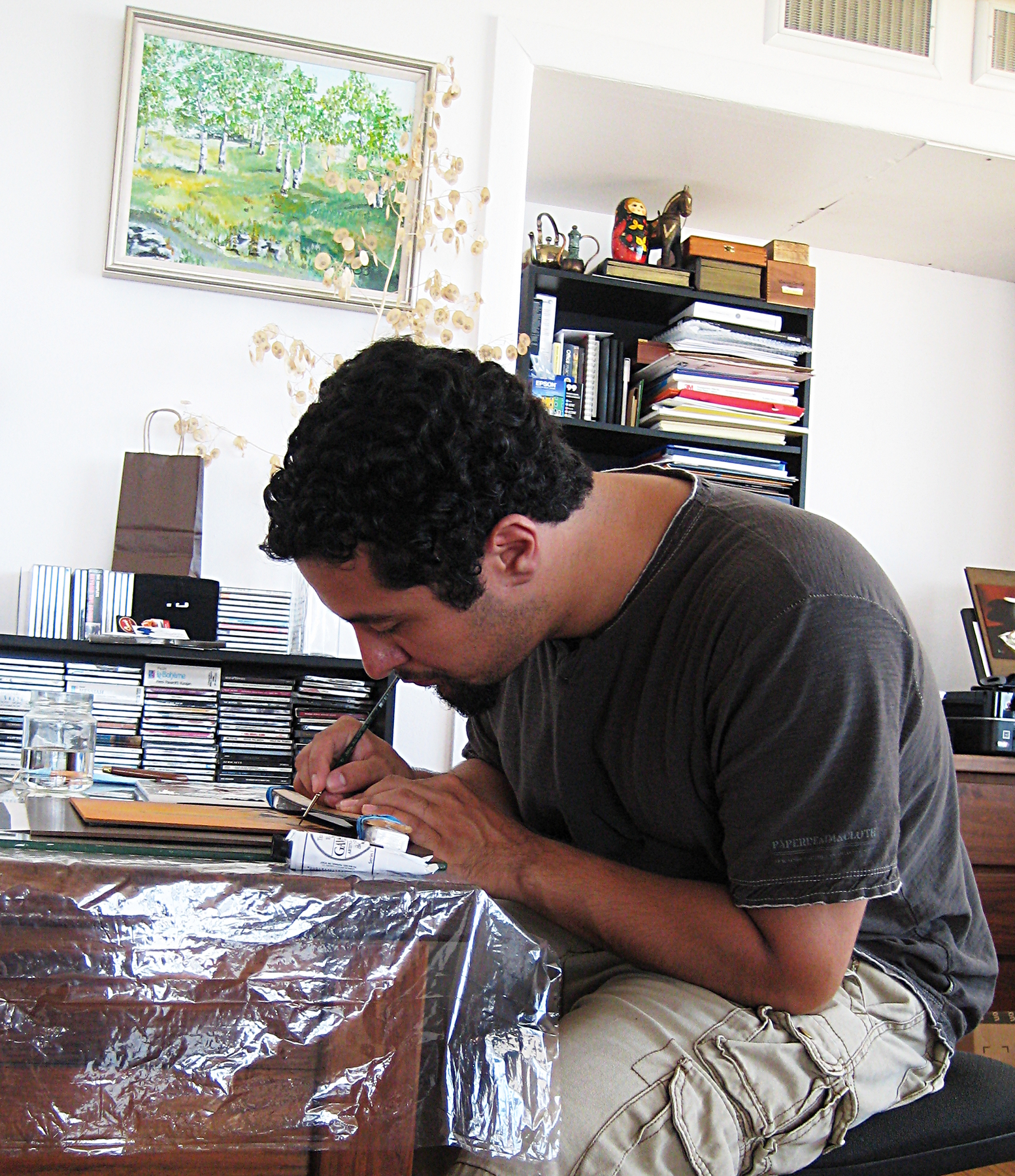
I use several sources as references for painting. I paint from the laptop screen, which is very convenient because I can enlarge details and lighten darks to see better. And I use a printed reference, which is convenient in a different way because I can rotate it. I also have my objects present so I can see the real colors.
I wait until my imprimatura layer is dry and begin the background. I usually work background to foreground and dark to light. The difficulty starts when my background is light and foreground is dark. In this case I abandon reason and work easy passages first and difficult ones later.
I let the background dry overnight. I prefer it to be reasonably dry, but it is not a must. If it is still tacky next day, I begin painting my foreground composition anyway using a painting bridge.
It usually takes several days to paint the first color layer. When the first layer is dry to touch I often do a coat of retouch varnish to even up sunken colors and assess where I am.
Then I do the second color layer, correcting, deepening, creating variations, adding details and brightening highlights. I may use Galkyd medium in the second layer.
Second layer complete I add another coat of retouch varnish and assess again. Often at this stage the painting begins to speak to me, telling me it is time to round things up. When I hear that, I correct mistakes I can find and get out my “Finishing a Painting Checklist.”
Reading books, blogs, talking to painters and making paintings myself I compiled a list of things to check at the final stages of a paining. I go through it and check and correct things. But it is not as analytical as it sounds. Sometimes I see something that needs changing according to my list, but I like it the way it is and leave it. In fact, I disregard a lot of rules, some of them rather fundamental.
Against well known and well established rules:
- I paint flat on a table
- I use small, smaller and smallest brushes
- I love details and paint a lot of them
And I am unrepentant and unapologetic.
I sign my small paintings with initials only. When a painting is sold or goes to a show I add a label in the back with a title, media, my full name, and year painted.
I let my small oils dry for at least a week before I varnish them. I use Gamvar varnish applied with a brush.
Like this:
2 bloggers like this post.